
Key Takeaways
-
What R-value is and how it measures insulation’s ability to resist heat flow
-
Why a higher R-value doesn’t always mean the best choice for every home
-
Factors that affect real-world performance: moisture, air leaks, compaction, and installation quality
-
Comparison of insulation materials by R-value (spray foam, rigid boards, fiberglass, cellulose, aerogel, eco-friendly options)
-
DOE-recommended R-values for California’s coastal and inland regions
-
Cost vs. long-term savings of high R-value insulation materials
-
How insulation works together with air sealing, ventilation, and HVAC efficiency
-
Practical tips for choosing the right insulation type for your home and climate zone
-
Expert recommendations on balancing comfort, cost, and durability
-
Benefits beyond energy savings: indoor air quality, soundproofing, and moisture control
What Is R-Value and Why It Matters
R-value measures how well an insulation material resists heat flow. The higher the number, the better the material insulates per inch of thickness. For homeowners, this number matters because it affects the energy efficiency of the property, as well as the comfort and monthly utility costs. According to the U.S. Department of Energy (DOE), proper insulation is one of the most cost-effective ways to lower your energy bills and greenhouse gas emissions.
At Pure Eco, we explain R-value to clients as the “thermal resistance shield” of your home. Proper insulation prevents heat loss during chilly winter nights and can reduce energy bills. This is what we refer to as maintaining a stable indoor temperature throughout the year.
Factors That Influence R-Value Performance
The R-value listed on insulation is a lab rating achieved under perfect conditions. However, in real homes across California, performance can fluctuate significantly based on several factors:
Moisture: In coastal areas, salty air and high humidity can make the attic insulation absorb moisture. In inland regions, roof leaks during winter storms also damage insulation. Once insulation becomes damp, it loses a lot of its effectiveness.
Air leaks: Many older homes in Los Angeles and the San Fernando Valley have tiny gaps around attic hatches, recessed lighting, or older windows. Air leaks through them and accelerates heat transfer. This reduces the effectiveness of even the highest R-value insulation.
Compaction or settling: Loose-fill cellulose or fiberglass can sag or settle over time, especially in attics that get shaken by frequent minor earthquakes. When insulation compresses and becomes thinner, its R-value drops.
Installation quality: Even the best insulation material can underperform if it’s not installed correctly. Gaps, compression, or poor air sealing reduce real-world effectiveness. The Building Science Corporation, in its Thermal Metric Summary Report (summarized by Green Building Advisor), found that when walls are built to the same R-value and properly sealed, all insulation types perform about the same. This means that professional installation and air sealing often matter as much—or more—than the insulation type itself.
Our senior technical specialist explained: “Even the best insulation won’t work if it isn’t installed correctly. Small gaps or uneven coverage can waste energy and make your home less comfortable.
Highest R Value Insulation Materials (Per Inch)
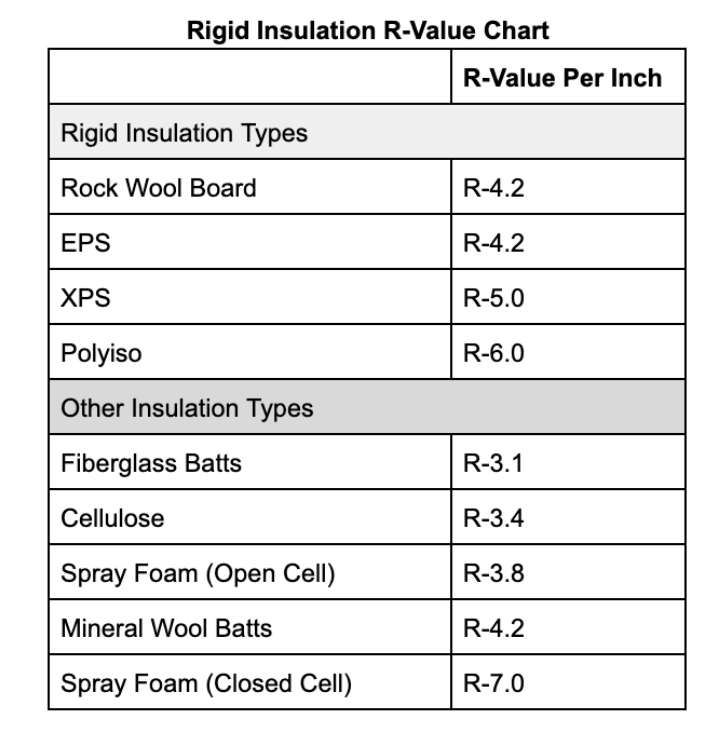
Closed-Cell Spray Foam. Closed-cell spray foam is one of the top performers, usually giving R-6 to R-7 per inch. In addition to blocking heat very well, it also seals out air leaks and even helps make walls and ceilings stronger.
Rigid Foam Boards (Polyiso, XPS, EPS). Rigid foam boards come in a few types: polyisocyanurate (Polyiso) with about R-6 per inch, extruded polystyrene (XPS) at around R-5, and expanded polystyrene (EPS) at about R-4. These boards are often used in attics, basements, or on the outside of walls. They are tough, moisture-resistant, and long-lasting.
Fiberglass, Cellulose, and Other Traditional Options. Fiberglass batts and blown-in cellulose are still very common because they are affordable and easy to find. Fiberglass gives about R-2.7 to R-3.7 per inch, and cellulose is around R-3.2 to R-3.8 per inch. While they don’t insulate as well as spray foam or rigid boards, they are budget-friendly and easier to install in many homes.
How Are R-Values Calculated
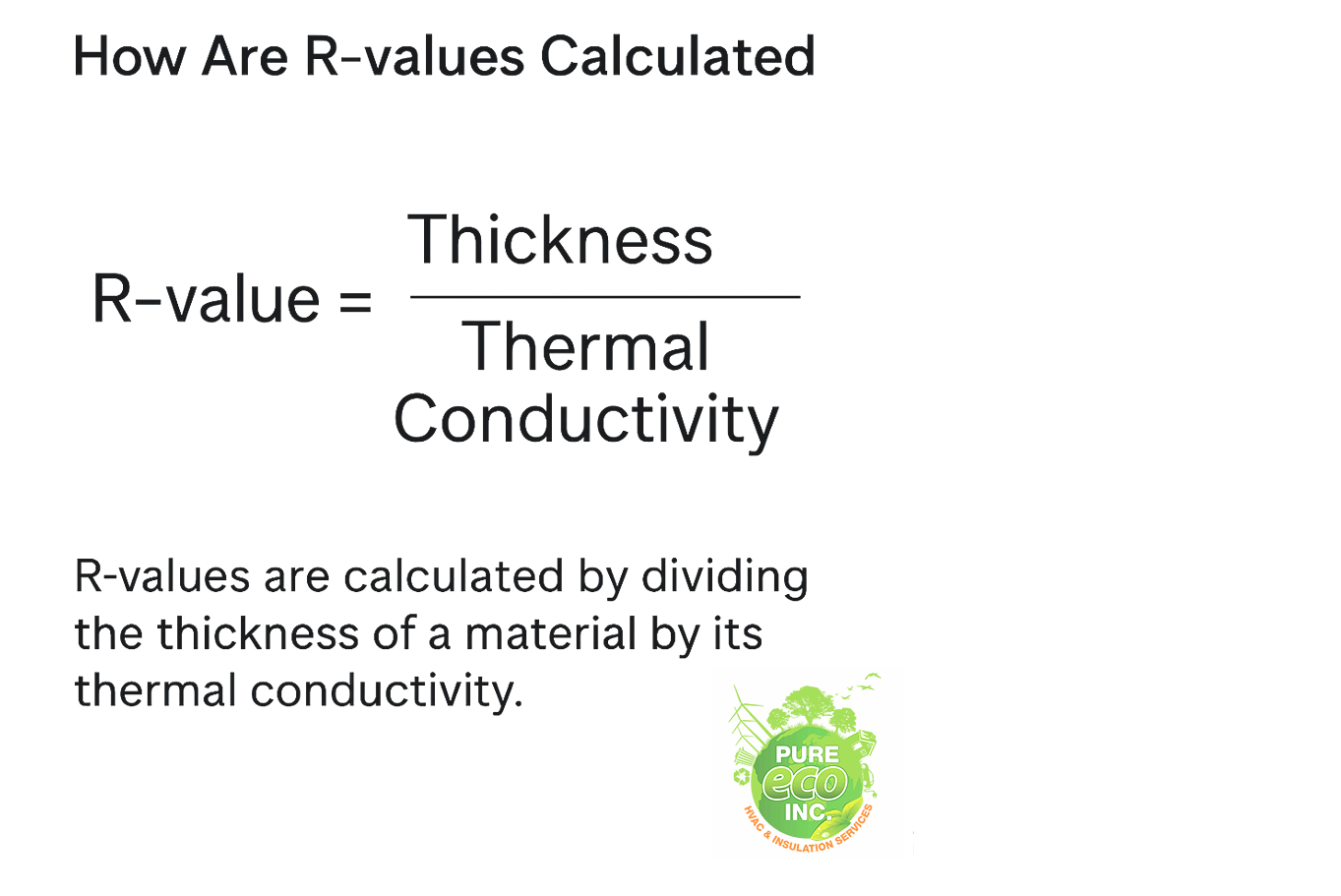
R-value is a number that tells you how well a material slows down heat. It’s calculated by measuring the material’s thickness and how resistant it is to heat flow. The formula is R = thickness ÷ thermal conductivity. In simple terms, the thicker and less heat-conductive a material is, the higher the R-value. For homeowners, this just means that a higher R-value insulation keeps your home warmer in winter and cooler in summer.” Beni, Senior Technician, Pure Eco Inc.
Advanced and Specialized High R Value Insulations
VIPs can reach R-25 to R-30 per inch. They are one of the highest-performing insulation types available. However, they are rarely used in homes because they are very expensive and can be difficult to install without damage.
Aerogel provides about R-10 per inch. It is extremely light and thin, and it’s mostly used in advanced industries like aerospace. Only a small number of homes use it today, though it may become more common in the future.
For homeowners who want sustainable choices, natural materials like cork, sheep’s wool, and hemp are available. They provide R-3 to R-4 per inch. While they don’t insulate as strongly as spray foam or foam boards, they are renewable, biodegradable, and can also help control for indoor humidity.
Does the Highest R Value Mean Best Insulation?
Not always. A higher R-value does mean better resistance to heat flow, but that doesn’t automatically make it the best option for every home. The right choice depends on factors such as the local climate, how well the insulation manages moisture, whether soundproofing is important, the level of eco-friendliness you want, and the balance between cost and practicality.
Our experts at Pure Eco advise homeowners to think holistically. The “best” insulation isn’t just about the number on a chart—it’s about the total package: comfort, energy savings, indoor air quality, sound control, and durability in your space.
Our Senior Technician at Pure Eco Inc. prepared this diagram to make things clearer for homeowners. It shows that while R-value measures resistance to heat flow, it’s not the only factor that matters.
On the chart, you can see how performance depends on climate, moisture control, soundproofing, and cost, not just the number on the label. Use this diagram as a guide to compare insulation options. Think about your home’s condition and long-term comfort; match these requirements to the right R-value. This is the smart choice that balances efficiency, cost, and durability.
Recommended R Values by Climate Zone
The DOE (U.S. Department of Energy) sets recommended insulation levels based on climate zones across the country. These recommendations help homeowners get the best balance of comfort and energy savings without overspending.
For California:
- Southern coastal areas (Zone 3): This includes places like Los Angeles, San Diego, and much of the coastal region. Attics here should be insulated to at least R-30 to R-49. Since winters are mild, you don’t need extreme insulation, but summers can be hot, so insulation helps prevent unwanted heat gain and keeps cooling bills down.
- Inland valleys and colder regions (Zone 4): Areas such as the San Fernando Valley, Sacramento Valley, and foothill or mountain regions have hotter summers and colder winters. These homes often need more insulation, usually R-38 to R-60 in the attic, to keep energy costs manageable year-round.
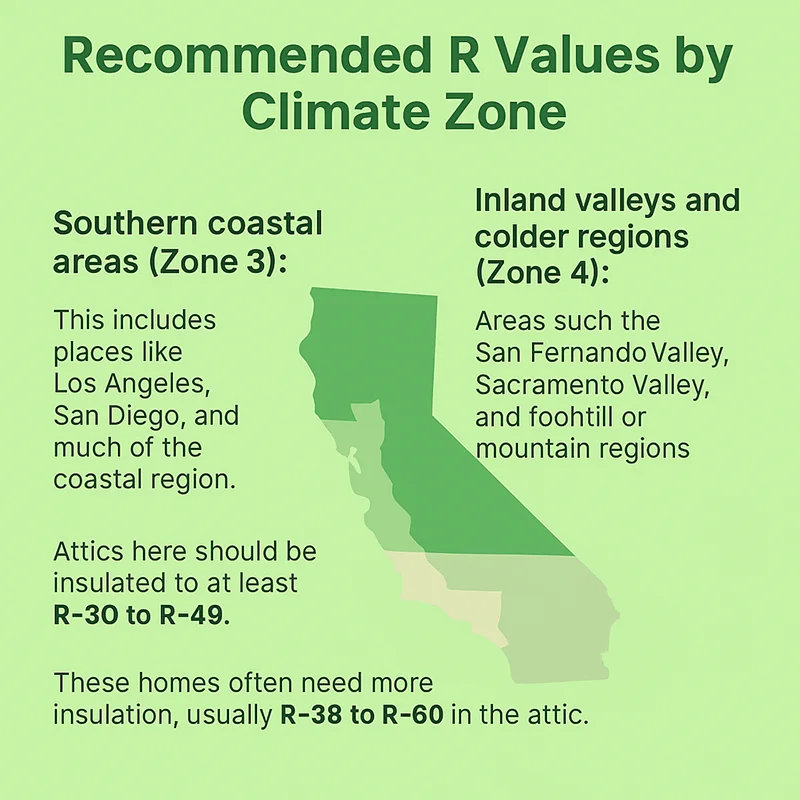
At Pure Eco, we believe that the right insulation for Los Angeles homeowners should be at least R-38 or higher in their attics. This level balances performance and cost and prepares homes for increasingly hot summers and the risk of wildfire smoke infiltration. For homes near the coast, we also take into account moisture and salty air, which can affect how insulation holds up over time.
How to Achieve the Best Overall Insulation Performance
Even the highest R-value insulation won’t give you full comfort if other problems in your home aren’t fixed. Insulation is just one piece of the puzzle. To get the best results, it should be combined with other steps:
- Air sealing: Small cracks and gaps around windows, doors, ducts, or attic hatches let air leak in and out. This can cancel out the benefit of high R-value insulation. Our team seals these gaps to keep conditioned air inside and outdoor air out.
- Moisture control: If insulation gets damp, it quickly loses its effectiveness. You should have your roof checked for leaks and seal crawl spaces. Humidity management is just as important as adding insulation.
- Proper ventilation: Attic ventilation prevents heat buildup in summer and moisture problems in winter. Without it, even good insulation will underperform.
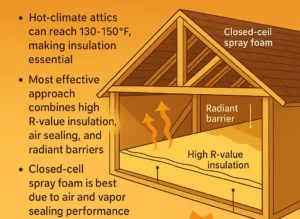
- Radiant barriers: In hot California summers, radiant barriers installed under the roof can reflect heat away to reduce the load on insulation.
Efficient HVAC systems: Insulation reduces the demand on your heating and cooling system, but if your HVAC is old, leaking, or undersized, your comfort and savings will still suffer.
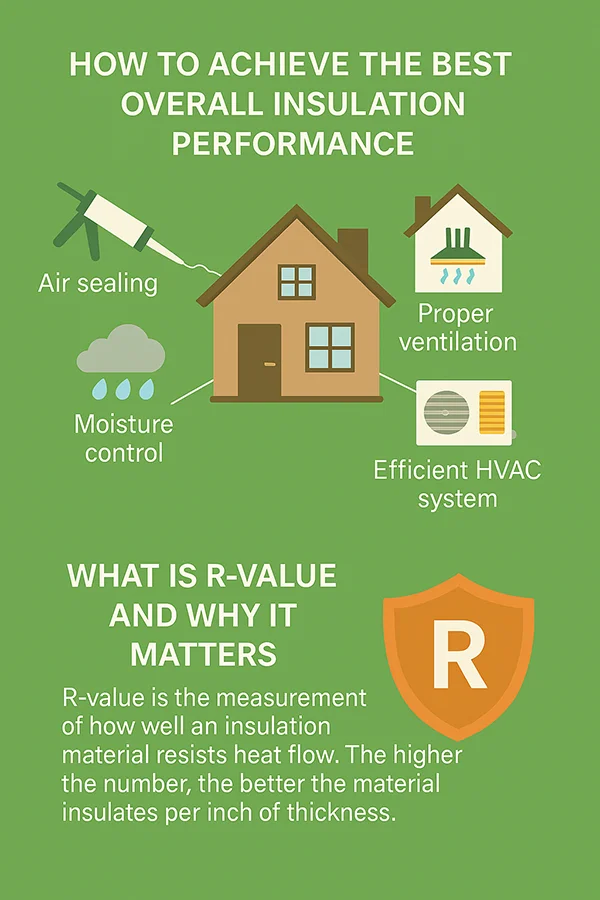
At Pure Eco, we often explain it this way: insulation works best as part of a whole-home energy strategy. When sealing, ventilation, and HVAC are optimized together, homeowners see lower bills, stable indoor temperatures, and healthier air. The right amount of insulation, combined with sealing and ventilation, delivers the best year-round comfort.
Schedule a free Pure Eco assessment today to find where your home is losing energy and get a personalized plan to fix it.
Cost vs. Long-Term Savings of High R-Value Insulation
High-performance insulation materials such as spray foam or aerogel usually cost more at the beginning. However, they can lower heating and cooling bills by as much as 40% because they do a better job at keeping indoor temperatures stable.
According to DOE studies, when insulation is installed correctly, the energy savings are so significant that the investment often pays for itself in just a few years. After that, homeowners continue saving money every month for the life of the insulation.
Lower-cost options like fiberglass or cellulose are cheaper upfront but usually need to be installed in thicker layers to reach the same R-value. They may also need to be replaced or topped up sooner, which can add costs over time.
In California, the right insulation often depends on both climate and homeowner priorities. In the hot inland valleys, higher R-value spray foam is usually the smarter investment because it keeps homes cooler during heat waves and provides long-term savings.
Along the coast, fiberglass or cellulose can be enough, alongside proper air sealing, though it’s important to account for moisture resistance for best performance.
The right insulation product depends on whether you prioritize upfront savings or lifetime efficiency. At Pure Eco, we help homeowners compare upfront cost vs. lifetime value, so you can choose the option that best balances your budget, comfort, and long-term savings.
Practical Tips for Choosing the Right Insulation for Your Home
- Match insulation type to space: spray foam in tight cavities, fiberglass batts in open walls, rigid boards for basements.
- Consider California’s building codes and DOE guidelines for your climate zone.
- Weigh the environmental benefits if sustainability is a priority.
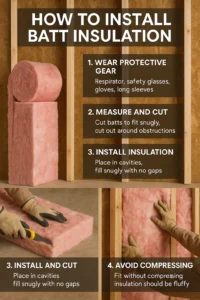
- To be sure you’re making the right choice, ask for professional installation; even DIY-friendly fiberglass can underperform if not fitted properly.
As one of our senior technicians often says: “It’s not just about R-value on paper—it’s how your insulation works in your real-world home.”
Conclusion and Expert Recommendations
The materials with the very highest R-values per inch are advanced options like aerogel and vacuum insulation panels. While they perform exceptionally well in laboratory conditions, they are extremely costly and not practical for most homes in California.
For the majority of homeowners, closed-cell spray foam or rigid foam boards are the best balance of high performance, durability, and reasonable cost. They insulate very well, seal out air leaks, and hold up well against California’s climate challenges, such as long, hot summers, wildfire smoke, and coastal humidity.
Traditional fiberglass or cellulose is a reliable and cost-effective choice if you are on a budget. Even though their R-values are lower, they still offer meaningful energy savings and improve comfort, when combined with proper air sealing. These materials can be excellent solutions for families who want to improve efficiency without a large upfront investment.
At Pure Eco, we want every homeowner to have insulation that balances comfort, cost, and long-term performance. That’s why we recommend looking beyond just the R-value. The best insulation is the one that fits your home, climate, and budget. Consider the quality of installation, since even the most expensive materials won’t perform well if gaps are left behind.
In coastal or humid areas, humidity management is important because humid air can seep through and create mold. Humidity reduces the effectiveness of insulation.
Insulation should also keep your internal air quality and help block dust, pollutants, and even wildfire smoke when combined with proper air sealing.
Finally, think about long-term savings. Quality insulation can pay for itself quickly and continue reducing energy bills for decades.
Modern insulation goes hand in hand with professional installation, air sealing, and HVAC optimization, When these work together, California homeowners can enjoy lower energy bills, more consistent comfort, and a healthier home space.
Highlights:
- R-value measures insulation’s ability to resist heat flow; a higher R-value means better performance per inch.
- Closed-cell spray foam and rigid foam boards offer the highest R-values per inch.
- Advanced materials like aerogel and vacuum insulation panels deliver exceptional performance but at a premium cost.
- The best insulation for your home depends on climate zone, installation quality, and long-term savings – not just R-value.
- In California, DOE recommends attic R-values between R-30 and R-60, depending on your zone.
- At Pure Eco, our experts advise balancing R-value with factors like moisture control, soundproofing, and environmental impact.
Faq
What is the highest R-value insulation per inch?
Closed-cell spray foam typically delivers the highest R-value per inch (around R-6 to R-7), followed by polyiso rigid foam boards. Some advanced materials like aerogel or vacuum insulation panels can reach even higher values, though they’re less common in residential use.
What R-value is best for attics in California?
According to the U.S. Department of Energy, most Southern California homes should aim for attic insulation between R-30 and R-60, depending on the climate zone and whether the attic is conditioned or unconditioned.
Does a higher R-value always mean better insulation?
Not always. While a higher R-value indicates more resistance to heat flow, performance also depends on installation quality, air sealing, and moisture control. Poorly installed high-R insulation may perform worse than properly installed lower-R options. If you’re looking for the best balance of cost and performance, spray foam or rigid foam boards are often the smartest options.
How long does spray foam insulation last?
Spray foam insulation can last 20–30 years or more if installed correctly. It resists sagging and settling compared to fiberglass or cellulose. It is a durable choice for homeowners looking for long-term benefits.
Is eco-friendly insulation effective for high R-values?
Materials like sheep’s wool, cork, or hemp have lower R-values per inch than spray foam, but when installed in sufficient thickness, they can still meet recommended standards. They also offer added benefits like moisture regulation and sustainability.
Sources:
- U.S. Department of Energy – Insulation
- EPA – Energy Efficiency
- Energy Star – Recommended Home Insulation R-Values
- Building Science Corporation
- https://www.greenbuildingadvisor.com/