

Key Takeaway
In this guide, you will learn:
- Why room acoustics matter for comfort, health, and productivity.
- The difference between large and small rooms and how sound behaves in each.
- Practical strategies to improve acoustics in your home, office, or studio.
- Affordable and advanced solutions, from rugs and curtains to bass traps and ceiling treatments.
- Common mistakes to avoid when treating acoustics.
By the end, you will know exactly how to make your space sound clearer, calmer, and more enjoyable.
Why Room Acoustics Matter
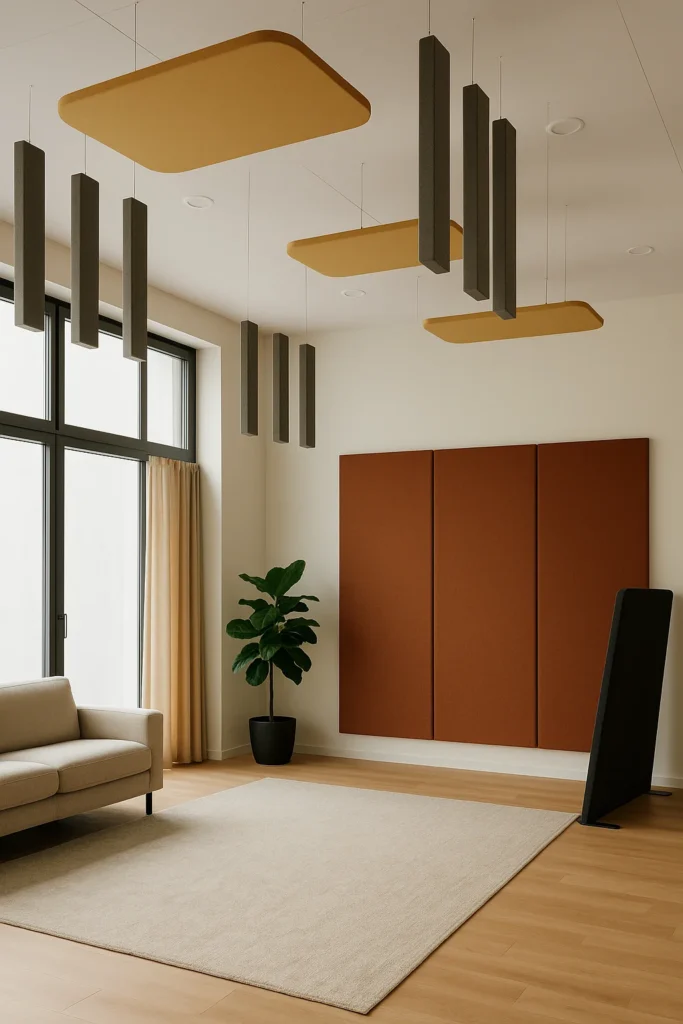
Good room acoustics are more important than many people think. They affect your comfort, how well you can understand speech, how music sounds, and even how productive you are at work. A room with the right sound balance feels calm and clear, while a room with poor acoustics can feel noisy, stressful, and tiring.
To make this simple, here are some key words you should know:
- Reverberation: when sound keeps bouncing in a room after the original sound has stopped.
- Echo: a strong reflection of sound you hear as a repeat, like when you shout in a canyon.
- Absorption: when materials (like curtains or panels) “soak up” sound instead of letting it bounce.
- Diffusion: when sound spreads evenly in different directions, so no single spot feels too loud.
The difference between good and bad acoustics is easy to notice. In a room with bad acoustics, voices may sound echoey or boomy, and it can be hard to follow a conversation. Music may feel harsh or unclear. In a room with good acoustics, the sound is balanced—voices are clear, music is pleasant, and the space feels comfortable.
It’s also important to know that acoustic solutions are not the same for every space. A large room needs a different approach than a small one. The use of the room matters too – what works for an office may not be right for a music studio.
“Every room is different. A small office and a large room will never need the same acoustic treatment. That’s why it’s important to choose solutions based on room size and purpose.” — Pure Eco Inc. Expert
In this guide, we talk about ge will firstneral ways to improve acoustics in any room. Then we will go deeper and explain special solutions for large rooms and for small rooms.
DANGERS OF NOISE POLLUTION
Noise pollution is a real problem. It’s not just the loud music from your neighbor’s party or the sound of traffic on a busy street. Noise pollution can also come from constant, low-level noise, like the hum of an air conditioner or the sound of refrigerators running in an apartment complex.
The World Health Organization has classified noise pollution as a danger to human health and for good reason. Noise pollution can cause a host of problems, including sleep deprivation, anxiety, and cardiovascular issues.
But there are some simple things you can do to reduce noise pollution. Wearing earplugs or noise-canceling headphones can be a temporary fix to block out some of the noise. But with constant low-level noise like that from an air conditioner, you need to find ways to overcome them by managing acoustics in your space.


The Acoustic Physics Behind Rooms
When sound moves inside a room, it does not just travel in a straight line. It meets walls, ceilings, floors, windows, and furniture. Each of these surfaces changes the sound in a different way. Some surfaces reflect it back, some absorb it, and some let part of the sound pass through. Other surfaces spread sound in many directions, which we call diffusion. Together, these actions decide if a room feels clear and pleasant or noisy and confusing.
Low and high sounds also behave differently. Low sounds, like a bass note, are harder to control because they travel further and pass through walls more easily. High sounds, like a clap or a sharp voice, are easier to stop with soft materials. This is why acoustic treatment must balance both low and high frequencies.
Another important idea is called reverberation time, also known as RT60. This is the time it takes for sound to fade away in a room after the source has stopped. If the sound keeps going too long, the room feels echoey and tiring. If it stops too quickly, the room can feel unnaturally “dead.” With the right balance, speech becomes clear and music sounds full. Today, even simple phone apps can help check reverberation in a room.
Rooms also have something called modes or standing waves. This happens when sound waves bounce between walls and combine in certain spots. In some areas, you hear the sound very strong, while in other areas it almost disappears. This is most common with low sounds and happens more in small rooms with flat, parallel walls. The shape and size of the room decide how strong these effects are. Proper design and acoustic panels can help control this and make the sound more even in all parts of the space.
“Sound is invisible, but its behavior is very real. Understanding how it reflects, absorbs, or spreads in a room is the first step to improving comfort.” – Soundproofing Expert at Pure Eco Inc.
HOW TO CHECK A ROOM’S ACOUSTICS?
To check the acoustics of your home, you can hire an expert or do it yourself by assessing if there are minimal echoes and low noise in the background in a room. Check if the sound distribution is uniform or not and the reverberation time is minimal or simply how quickly the sound fades away.
WHY IS MANAGING ACOUSTICS ON COMMERCIAL PREMISES IMPORTANT?
Acoustic comfort is important for homes, offices, and other settings such as retail shops and hospitals. Good acoustics in offices is important for several reasons. It can help with productivity by reducing distracting noises, thereby, improving your concentration. These panels increase privacy to stop people from listening to conversations, especially in board room meetings.
Noise can be either inside or outside of your building and it could be loud or soft. A lot of people are exposed to noise levels at work that may lead to hearing loss. Unsafe noise levels on the job could lead to hearing loss, tinnitus, or other ear problems.
Noise pollution can have adverse effects on people’s health. It can cause stress and anxiety that can lead to cardiovascular diseases such as hypertension and even heart attack in some cases. It has the potential to affect your hearing capabilities and the quality of your sleep. This is why hospitals pay special attention to acoustics in rooms as it helps increase the privacy and comfort of the patients. Patients will find it hard to recover if they are exposed to loud noises. External noise dangerously contributes to increased blood pressure, and heart and breathing rates and can cause cognitive impairment and sleep disturbance.
Similarly, retail shops want to improve consumer experience and don’t want sound from outside road traffic to be a nuisance to their customers. Furthermore, people in offices or students in a school or university will find it hard to concentrate if there is noise coming from outside.

Core Strategies to Improve Room Acoustics
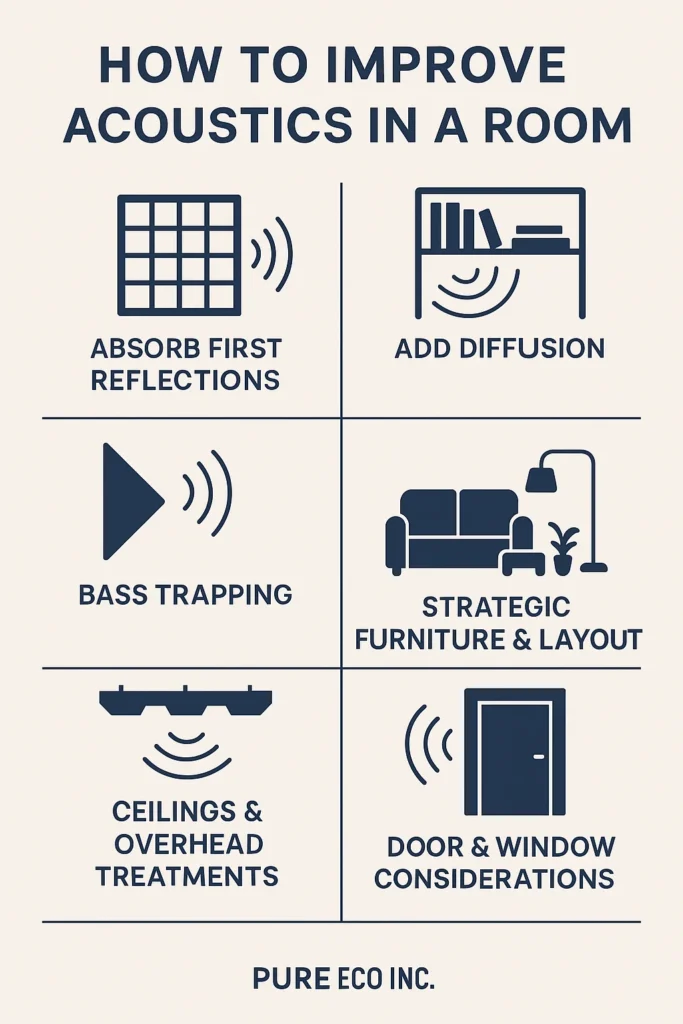
Improving the sound in a room is not about one quick fix. It is usually a mix of different steps that work together. Below are the main strategies our experts at Pure Eco Inc. recommend.
Good acoustics start with controlling the first reflections of sound. These are the first places where sound bounces after leaving the source. By placing wall panels, thick curtains, or rugs in these spots, you reduce sharp echoes and make voices and music sound clearer.
Diffusion is another important step. Instead of stopping sound, diffusers scatter it around the room so no single place feels too loud. Bookshelves, shaped furniture, or special panels can act as natural diffusers and give the space a balanced sound.
Low sounds, such as bass, often create the biggest problems. They build up in corners and make the room feel boomy. Bass traps, which are special panels for corners and walls, help control these deep sounds and make the overall sound smoother.
Furniture and layout also play a big role. Empty rooms with flat, parallel walls create more echo. Heavy furniture, plants, and shelves break up the sound path and add natural absorption. Using angles instead of straight lines also helps reduce echo.
Ceilings are often forgotten, but they have a big impact on sound. Hanging acoustic clouds or ceiling baffles can control reflections from above, especially in tall rooms.
Doors and windows are weak points where sound leaks in or out. Thick curtains, seals around doors, or window plugs reduce this problem and keep the room quieter.
Different acoustic products and materials are available. Options include mineral wool, fiberglass, foam, wood panels, and acoustic fabrics. Each has its own cost, look, and performance level, so it is important to choose what fits both your needs and your budget.
Acoustic work should not stop after the first try. Testing with a simple app or just listening while moving around the room helps you see where improvements are still needed. Adjusting placement of panels and furniture often makes a big difference.
Budget is another factor. Some improvements are simple and cheap, like adding rugs or curtains. Others, such as custom wall panels or full ceiling treatments, cost more but bring stronger results.
Finally, acoustics can look beautiful too. Modern products include art panels, design baffles, and furniture that combine good sound control with stylish looks. This way, you don’t have to choose between performance and decoration – you can have both.
How to Improve Acoustics in a Large Room
Large rooms, such as halls, big living rooms, studios, or conference centers, often have unique sound problems. Because the space is wide and open, sound travels longer, which creates strong echoes and long reverberation times. Low sounds also collect in corners and along walls, making the room feel boomy and unclear.
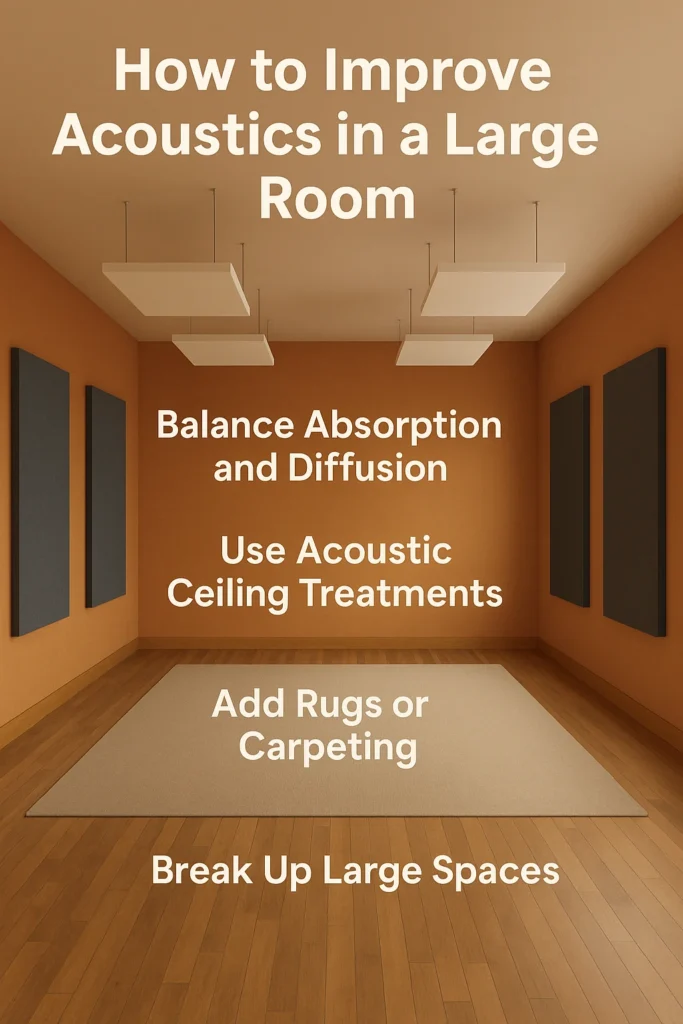
The key is to combine absorption and diffusion. Absorption reduces sharp reflections so speech becomes clear. Diffusion spreads sound evenly, so the room stays lively instead of flat. Using both together gives the best results.
Ceilings are a good place to start. Hanging baffles, acoustic clouds, or large panels reduce reflections from above. For the walls, tall acoustic panels, fabric-wrapped art, or decorative coverings help control echo around the edges. Floors should not be ignored—large rugs or carpets with under-padding stop sound from bouncing too much on hard surfaces.
In big spaces, bass traps are important. Low frequencies are harder to control, so larger or multiple traps in corners and along walls are often needed. Another smart strategy is zoning. By adding partitions, screens, or even large furniture, you break up the room into smaller areas and shorten sound paths, which lowers echo.
Examples of this are easy to see. Concert halls use special ceiling and wall panels to control sound for music. Conference rooms often rely on carpets, wall panels, and ceiling treatments for clear speech. Open offices use hanging panels, plants, and partitions to keep noise comfortable for workers.
The cost depends on the size of the room and the level of treatment. Simple fixes like rugs or curtains are budget-friendly, while custom panels and ceiling designs are more expensive. Still, the investment brings real benefits: better communication, improved comfort, and a space that feels professional and welcoming.
How to Improve Acoustics in a Small Room
Small rooms, like bedrooms, offices, rehearsal spaces, or home studios, often have their own sound problems. Because the space is tight, sound waves bounce quickly between the walls. This creates strong peaks and dips in bass and makes some spots sound too loud while others sound too quiet.
A good starting point is to place absorbers in the right places. Corners and the first-reflection points on the walls are the most important. Adding panels or thick materials here will stop sharp echoes and make voices clearer.
For low sounds, bass traps are very useful. In small rooms, triangular corner traps or membrane panels work well to reduce the heavy, boomy feeling that bass can cause.
Diffusion can also help, but it should be gentle. Large, heavy diffusers are too strong for small spaces. Instead, low-order diffusers or furniture with uneven surfaces can spread the sound more naturally.
Furniture is a simple way to improve acoustics too. Bookshelves, wardrobes filled with clothes, or padded chairs act like natural absorbers and make the room sound softer.
Windows and doors are weak points where sound escapes or enters. Thick curtains, door seals, or acoustic door sweeps can make a big difference.
Even the ceiling can help. Low-profile absorbers or small ceiling baffles improve sound without lowering the room too much.
It is also important to test and adjust. Playing test tones or using apps that measure sound helps you understand where the problems are. Moving panels or traps just a little can change the sound balance a lot.
Real examples show this clearly. A small recording room uses corner traps, wall panels, and a rug to control echo. A small home office may only need curtains, a thick carpet, and a bookshelf to make speech more clear during calls.
The right mix of treatments will turn a small, noisy room into a space that feels balanced, comfortable, and ready for work, music, or relaxation.
“Good acoustics do not always mean expensive solutions. With the right curtains, a carpet, and a few well-placed panels, even a small home office can sound professional.” — Pure Eco Inc. Expert
Large Room vs Small Room – Acoustic Comparison
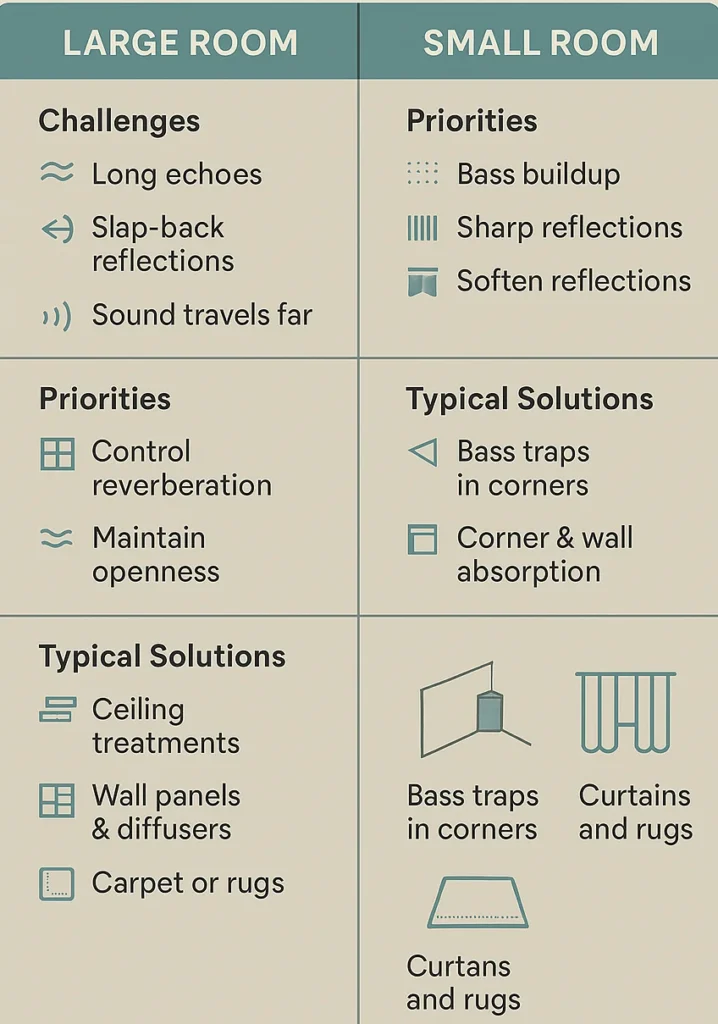
Large and small rooms do not behave the same when it comes to sound. Each has its own challenges and needs different solutions. Understanding these differences will help you choose the right acoustic treatment for your space.
| Aspect | Large Room | Small Room |
| Main Challenges | Long echoes, slap-back reflections, sound travels far | Bass buildup, sharp reflections, uneven sound |
| Priorities | Control reverberation, maintain openness, and add diffusion | Control low frequencies, soften reflections, focus on clarity |
| Best Treatments | Ceiling clouds or baffles, wall panels, diffusers, carpets | Bass traps in corners, wall absorbers, rugs, and curtains |
| Extra Tips | Use partitions or furniture to break up sound paths | Use furniture (bookshelves, wardrobes) as natural absorbers |
| Mistakes to Avoid | Using only absorption (the room becomes too “dead”) | Ignoring the bass and using only thin foam panels |
Which Acoustic Fix Fits Your Room?
Not every room needs the same acoustic treatment. The size and shape of your space decide whether you should focus more on echo control or bass problems. Use this simple guide to see if your room needs large-room or small-room solutions.
Step 1. Look at your room size and ceiling height
- If your room is over 30 sqm or has high ceilings (3m+) → treat it as a large room.
- If your room is under 20 sqm or has low ceilings (under 2.5m) → treat it as a small room.
- If your room is between 20–30 sqm → mix both strategies: bass control + some diffusion.
Step 2. Choose your priorities
- Large Room → reduce echo, balance sound with diffusion, treat ceilings and walls.
- Small Room → fix bass buildup in corners, soften reflections with rugs, curtains, and panels.
Step 3. Apply the right solutions
- Large Room → add ceiling clouds or baffles, wall panels, diffusers, and carpets. Use partitions if the space feels too open.
- Small Room → install corner bass traps, add wall absorbers, use furniture and curtains to soften sound.
Step 4. Avoid common mistakes
- Large Room → don’t cover everything with absorbers, it will sound “dead.”
- Small Room → don’t rely only on thin foam panels, they don’t control bass.
BENEFITS OF GOOD ACOUSTICS IN HOMES
GIVES PEACE OF MIND
If you live in a place where there are lots of construction sites, factories, etc., nearby, soundproofing your home can give you peace of mind. Soundproofing will also help protect your family’s health and reduce the chances of noise damaging their ears.
A RELAXING ENVIRONMENT
Acoustic comfort contributes to the mental health and overall wellness of the occupants living in a home. The sound of your environment can influence how you feel about yourself, ultimately affecting your health. Most importantly, soundproofing your home can ensure you sleep better, relax after a long day, and even lower your stress levels.
ENHANCES MOOD
It’s not just bad news for your ears: if you’re not comfortable with the noise around you, it can affect your mood, productivity, and quality of life. In our modern world, a lot of people suffer from insomnia and other sleep disorders because of the noises around them.
GYM ECHO REDUCTION
A lot of people prefer to workout at home, which is why they build a home gym. However, operating treadmills at high speed or throwing dumbbells and kettlebells around can be a nuisance for the rest of the family. This is why measures for gym echo reduction should not be ignored.
BE A GOOD NEIGHBOUR
By soundproofing your home, you can have fun and host parties without disturbing your neighbors or getting in trouble with the law. This also helps to improve acoustics which leads to better music sound quality and experience for everyone within your home.
CAN HELP PEOPLE WITH ADHD
ADHD is a disorder that affects a lot of people globally. It can prevent people from performing well in their professional and personal lives due to problems with hyperactivity, impulsiveness, and not being able to focus. People with ADHD often have trouble paying attention, controlling their emotions, and staying on task. They also get easily distracted and have difficulty completing tasks. Exposure to loud noise can make it difficult to pay attention. Noise pollution can also cause anxiety and irritability, which can make it hard to control emotions and focus on a task.
People diagnosed with ADHD are sensitive to noise, and exposure to loud noise can trigger symptoms or make them worse. If you suffer from ADHD, it’s important to avoid exposure to loud noise whenever possible. If you can’t avoid noise pollution, there are some things you can do to minimize its effects. Wearing earplugs or noise-canceling headphones can help reduce noise exposure and create a quiet environment at home.

HELPS AVOID SENSORY OVERLOAD
Acoustic comfort also helps us avoid sensory overload by allowing us to focus on what we’re doing or thinking about rather than being distracted by other noises around us. Sensory overload can overwhelm people with anxiety disorders and make them feel unsafe. By soundproofing your home, you can minimize the noise that enters your home, making it a quiet and safe place for people with autism, anxiety disorders and for highly sensitive persons.
GOOD FOR PETS
Excessive noise can affect pets as well. Improving the acoustics in your home can ensure that your pets feel safe and don’t get overwhelmed by loud noises. You’d be surp0rised to know that noise pollution can affect their breeding cycles.


SOUND PROOF YOUR HOME TODAY
Tired of losing a good night’s sleep due to loud noises? It is about time you take control back in your own hands. At Pure Eco Inc., we are a team of highly experienced insulation contractors that go the extra mile to ensure perfect insulation for your property. We have a proven record of delivering reliable insulation installation across California, including San Fernando Valley, Tarzana, Monrovia, Rancho Cucamonga, and Los Angeles. Our services include soundproof insulation, crawl space insulation, and attic insulation in Monrovia.
Reach out to us for affordable insulation installation in Pomona. You can also email us at INFO@PUREECOINC.COM and our friendly staff will get back to you as fast as possible.
We also offer free consultations and full-fledged energy audits to help solve your problems according to your budget.
We also offer financing under the Green Sky Credit Program which helps ensure that money isn’t a constraint when it comes to getting the perfect insulation options in California. See what our customers have to say about us here.
FAQ
What is the easiest way to improve acoustics in a room?
Start with soft materials like rugs, curtains, and upholstered furniture. These absorb sound and reduce sharp echoes.
How do I reduce echo in a large room?
Use a mix of ceiling panels or baffles, wall absorbers, and diffusion elements such as bookshelves. Adding carpets and breaking up the space with furniture or partitions also helps.
How do I control bass in a small room?
Place bass traps in the corners and along walls. This stops low sounds from building up and makes the room feel less boomy.
Can furniture improve acoustics?
Yes. Heavy furniture, bookshelves, wardrobes, and even plants can act as natural absorbers and diffusers.
Do I need expensive panels to get good acoustics?
Not always. Many problems can be improved with low-cost fixes like rugs, curtains, and smart furniture placement. Custom panels and ceiling treatments are more effective but cost more.
How can I check if my room has good acoustics?
Clap your hands or play music and listen. If the sound feels too echoey, boomy, or unclear, you likely need treatment. You can also use simple phone apps to measure reverberation time.
Are acoustics important only for music rooms?
No. Good acoustics matter in homes, offices, classrooms, gyms, and even hospitals. They improve comfort, privacy, productivity, and overall well-being.